Why "design a kitchen" is the wrong starting point
We hear it every now and then. A client sends us some floor plans, and says: "I have 50 square metres marked for the kitchen. Can you work on the kitchen layout?"
It sounds reasonable. You have a space, you need a kitchen, you hire someone to fill it with equipment. But it is also working backwards. The space tells you where the walls are. It tells you where the drainage runs and where the gas riser lands or where the exhaust stubouts are. What it does not tell you is what the kitchen needs to do.
That answer lives in the menu.
A kitchen is not a room with cooking equipment in it. It is a production system built around a specific set of dishes, served at a specific volume, through a specific style of service. Change any one of those variables and the equipment changes, the layout changes, the ventilation changes, the refrigeration changes. The same 50 square metres can hold a burger kitchen, a Japanese kitchen, or an Indian kitchen. Three completely different equipment lists, three different ventilation loads, three different refrigeration footprints. By the end of this article, you will see all three, side by side, in the same shell.
We have done this exercise a number of times at Cleresdyne. Burger joints like Alien Burger, seafood concepts like John Dory, Spanish restaurants like Sobremesa, shisha lounges with full F&B, cloud kitchens running three virtual brands from one line, hotel banqueting halls doing 500 covers a night. Every project is different. Every one starts the same way: with the menu.
Not the floor plan.
The short version
- Your menu determines your kitchen, not your floor plan
- A kitchen contractor needs 7 inputs from you before touching CAD
- The same 50sqm space produces three completely different kitchens depending on the concept
- Late menu changes after layout approval cascade through the entire design
The input list: what the kitchen contractor needs before touching CAD
Before we open AutoCAD, before we sketch a single equipment block, we need seven pieces of information from you. Most clients arrive with two or three of these. Part of our job is helping you figure out the rest.
1. The menu. Not just the launch menu. The full list: mains, starters, desserts, specials, the items you plan to add in six months, the brunch menu you are still debating. Every dish implies a cooking method. Every cooking method implies a station. Miss a category now, and you will be retrofitting a station later.
2. Projected covers per service. How many meals per day, split by lunch and dinner (and brunch, if applicable). This is the single biggest driver of equipment sizing. The difference between 200 and 400 covers per day is the difference between one combi oven and two. Between a 6-tray unit on a stand and a floor-standing 20-tray — see combi oven sizing.
3. Service style. Counter service, table service, buffet, delivery-only, or some mix. A delivery-heavy concept needs a packaging station and a driver handoff point. A buffet needs holding equipment and a service line. Table service needs a pass and an expediting area. Each one reshapes the layout.
4. Operating hours. A cafe running 10 hours has a fundamentally different equipment load from a cloud kitchen running 22. Longer hours mean more wear, more redundancy, and different maintenance windows. A single combi running 22 hours a day will not last like one running 10.
5. Delivery percentage. If 40% of your orders leave the building, you need a packaging station, a pickup shelf, and a driver access point that does not clog the dining entrance. That percentage also changes how the pass is designed, because dine-in plating and delivery boxing are different workflows.
6. Staffing plan. How many cooks per shift matters more than people expect. Two cooks working a line need 1,200mm aisle widths so they can pass each other. A single cook can work in 900mm. The number of hands on the line determines how much separation each station needs, and whether you are designing for choreography or for independence.
7. Budget envelope. Not so we can design to a number, but so we know where the trade-offs land. A client with AED 400K for equipment makes different choices than one with AED 800K. We need to know early whether we would specify a 10-tray combi or a 6-tray, whether the walk-in chiller is required or a few reach-in chillers instead. The menu sets the need. The budget sets the path.
Most of these are decisions only you, the operator, can make. But understanding why each one matters downstream is the first step toward a kitchen that works from day one.
Station mapping: how menu items become cooking stations
This is where the design logic actually lives. Every item on your menu implies a cooking method. Every cooking method maps to a station. Every station requires specific equipment. The chain is always the same: menu item, cooking method, station, equipment.
Let us walk through two concepts to see how different this gets.
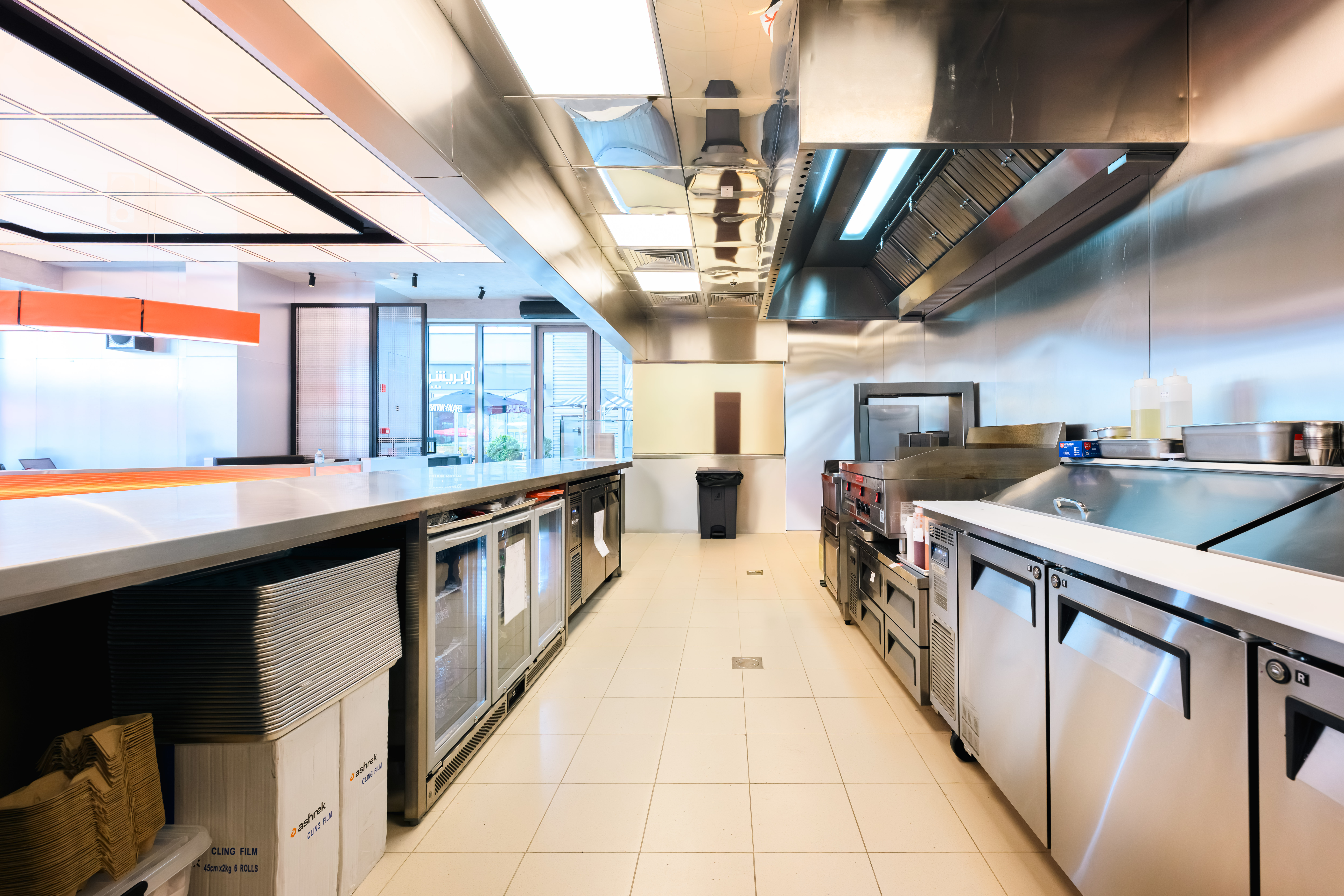
A burger restaurant at 300 covers per day. The menu is built around a flat grill. Smashed patties, toasted buns, melted cheese. That is your primary station: a 1,200mm flat griddle, because at 300 covers you are pushing through hundreds of patties a shift (a griddle that size can handle upwards of 2,400 burgers per hour at full capacity, which gives you headroom for peak). Wings, fries, and onion rings need a fryer bank: two or three fryers, each with dedicated tanks to avoid flavour crossover between chicken and potato. Buns get toasted under a salamander or in some cases a vertical bun toaster. Then you have a cold prep station for lettuce, tomato, pickles, sauces. A milkshake station with blenders. Maybe a soft ice cream machine.
The cooking line is dominant. It takes the most space, draws the most power, and sits under the longest hood run. Cold prep is compact (one or two prep tables with reach-in refrigeration underneath). Walk-in storage is modest because protein turns over fast in a burger operation. You might need two reach-in fridges and a small walk-in cooler.
Now take a Japanese concept at the same 300 covers. Sashimi, maki, nigiri. The menu is built around knife work, not fire. Your primary stations are precision cutting tables with dedicated fish refrigeration. You need a sushi display case for the front of house. Rice prep becomes its own station (commercial rice cookers, seasoning vessels, holding). Tempura gets a smaller fryer setup than the burger kitchen (one fryer, not three). Ramen broth needs a dedicated stockpot burner running for hours. Maybe a robata grill for yakitori.
The cooking line shrinks. Cold prep and refrigeration expand dramatically. Where the burger kitchen might have two reach-in fridges, the Japanese kitchen needs five. Possibly a dedicated small walk-in for fish, held at a tighter temperature range than a general-purpose cooler. The most expensive line item in the Japanese kitchen is not the cooking equipment. It is the cold chain.
And the numbers confirm the difference. For the burger concept, 1 to 1.5 cubic feet of refrigerated storage per meal per day is a reasonable planning figure for casual dining. For a fish-heavy Japanese concept, that ratio climbs significantly because of the volume, variety, and temperature sensitivity of the protein. More species, more cuts, more temperature zones, more backup stock.
Equipment follows stations, not the reverse. If your menu needs roasting, steaming, and baking at 300 covers, the answer is a 10-tray floor-standing combi oven (20 GN 1/1 pans, enough for 200 to 400 servings per batch cycle). At 100 covers, a 6-tray countertop might suffice. At 500, you are looking at a 20-tray unit or paired 10-trays.
Sometimes one piece of equipment changes the entire station map. We recently specified an Alto-Shaam Vector oven for a cafe concept. Each chamber in the Vector runs at a different temperature independently, so baking, roasting, and holding happen in a single footprint. What would have been three separate stations collapsed into one. For a small cafe kitchen where every square metre counts, that is not just an equipment choice. It is a layout decision.
The menu sets the cooking method. The covers set the capacity. The station map bridges what the restaurant serves and what the kitchen contains.
The workflow test: tracing a plate from walk-in to pass
You can have the right equipment in the wrong arrangement. A kitchen where cooks double back to reach the fryer, where raw chicken crosses paths with plated salads, where the dishwasher blocks the service corridor during peak. The equipment is correct. The layout is broken.
We test every layout the same way. Pick any dish on the menu. Trace its journey from the moment the raw ingredient arrives at the back door to the moment the finished plate leaves the pass. Receiving to storage. Storage to prep. Prep to cooking line. Cooking line to plating. Plating to the pass. If anyone has to double back, cross another cook's path, or carry food through the wash area, the layout has a problem.
This is the one-way current principle. Each zone feeds the next one in sequence. Receiving feeds storage. Storage feeds prep. Prep feeds the cooking line. The cooking line feeds the pass. Dirty dishes flow back to warewashing without crossing the clean food path. The current only moves forward.
There is a food safety dimension here that goes beyond efficiency. Under HACCP principles (and Dubai Municipality enforces them), raw and ready-to-eat food paths cannot cross. Raw chicken cannot travel past plated food. Unwashed vegetables cannot share a prep surface with cooked rice. This is not a preference or a best practice. It is a regulatory requirement. An inspector will flag it, and the fix after construction is not a conversation. It is a rebuild.
The physical separation between zones matters at a level most operators do not think about until it is too late. The raw meat prep area needs to be physically upstream of the cooking line, not beside the salad station. The dishwash return cannot route through food prep. Even the hand sinks have placement rules: within arm's reach of every prep area, because a cook who has to walk across the kitchen to wash hands simply will not do it often enough during a busy service.
Aisle widths matter more than most clients expect. A single cook working alone needs a minimum of 900mm of clear aisle. Two cooks passing each other need 1,200mm. A main traffic corridor, the kind where someone is carrying a hotel pan from the walk-in to the prep table, needs 1,500mm or more. Near oven and steamer doors, add extra clearance for the door swing. Get these wrong and service slows down every night, not because of the food, but because people cannot move.
We have seen kitchens where the layout looked clean on the CAD drawing. Symmetrical. Organised. Then you put six cooks in it during a Friday night service and the whole thing jams. The workflow test catches that before the steel is fabricated. Before the tiles are laid. Before the hood is hung. That is when fixing a layout costs a conversation, not a change order.
Three kitchens from one shell: burger, Japanese, Indian in 50 square metres
Here is the exercise. One rectangular shell, 50 square metres. Same walls, same door positions, same drainage points, same gas riser, same electrical capacity. Three different restaurant concepts walk in.
Watch what happens.
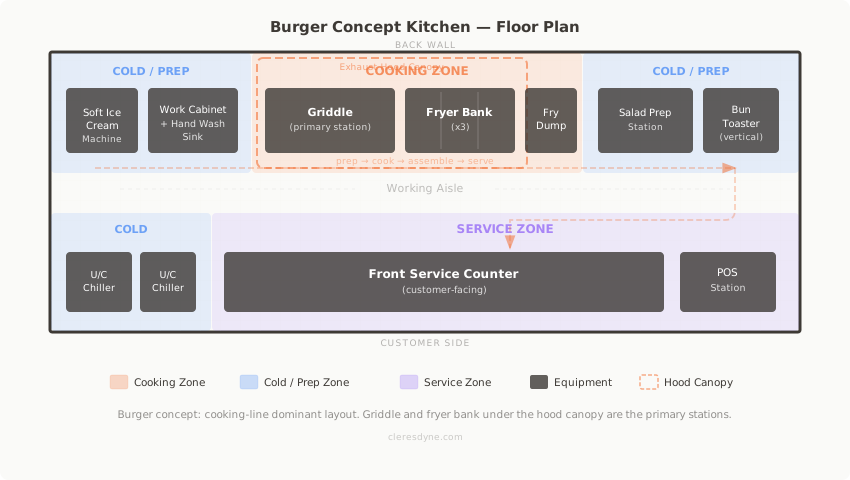
Burger concept: grill-and-fryer dominant.
Short cook times, high throughput. The cooking line takes the most space in this kitchen: a 1,200mm flat griddle, a bank of two to three fryers, a salamander for finishing, and a holding cabinet for prepped patties and toasted buns. Cold prep is tight and efficient (one long prep table with refrigerated drawers underneath for mise en place). The walk-in is modest because burger protein turns over daily. Two reach-in fridges handle the backup stock.
Ventilation is moderate. The griddle and fryer bank need a proper hood, but nothing extreme.
Budget weight: roughly 60% goes to the cooking line, 20% to refrigeration, 20% to prep, storage, and warewashing.
Japanese concept: cold-prep dominant.
This is a knife-and-cold-chain kitchen. The largest zone is refrigeration and cold prep. Two or three precision cutting stations, each with dedicated refrigeration underneath. A sushi display case for the front. Multiple reach-in fridges (five, where the burger kitchen had two) for different proteins, garnishes, and prepared components. Possibly a dedicated fish walk-in if the menu is sashimi-heavy.
The cooking line is the smallest of the three concepts. A tempura fryer (just one, where the burger kitchen had three). A few burners for ramen broth and rice. A small robata grill. The hood run is short.
But the cold chain is the most expensive element. All that refrigeration, the display case, the precise temperature holding, the backup power considerations. A Japanese kitchen's budget centres on keeping things cold, not making them hot.
Budget weight: roughly 60% goes to refrigeration and cold prep, 25% to the cooking line, 15% to storage and warewashing.
Indian concept: cooking-line dominant.
This kitchen runs hot. A tandoor oven is the centrepiece, and it alone demands significant ventilation extraction. Add a bank of four to six burners for curries, sauces, and dal. A fry station for samosas, pakoras, and bhajis. A large prep area for spice grinding, marination, and dough work (naan, roti, paratha all need space). A few bain maries to keep biriyani and gravies warm.
The cooking line is the deepest and hottest of the three. The tandoor, the burner range, and the fry station run at high temperatures for extended periods. The hood run is the longest of any of the three kitchens because of the combined heat load, and the tandoor alone has one of the highest ventilation coefficients of any single piece of cooking equipment.
Refrigeration is simpler than the Japanese concept. Spices are dry-stored. Proteins are fewer in variety (chicken, lamb, paneer, seafood). Two or three reach-ins along with standard walk-in chiller and freezer cover it.
Budget weight: roughly 60% goes to the cooking line and ventilation, 15% to refrigeration, 25% to prep and storage.
What changed? Everything except the walls.
The burger kitchen has 2 reach-in fridges. The Japanese kitchen has 5. The Indian kitchen has the longest hood run. The Japanese kitchen has the smallest cooking line but the most expensive cold chain. The tandoor in the Indian kitchen needs more extraction capacity than the entire burger cooking line.
Same shell. Same 50 square metres. Same utility connections. Three completely different kitchens, three different equipment lists, three different ventilation calculations, three different budgets.
This is why you design from the menu, not the space. The space did not change. Everything else did.
What changes when the kitchen is open to guests
A hidden kitchen has three priorities: efficiency, safety, compliance. An open kitchen has all three, plus a fourth: it has to look good.
Aesthetics enter the picture without any of the other priorities leaving. The food still needs to be safe. The workflow still needs to flow. The inspector still needs to pass it. But now, on top of all that, the kitchen is part of the dining experience.
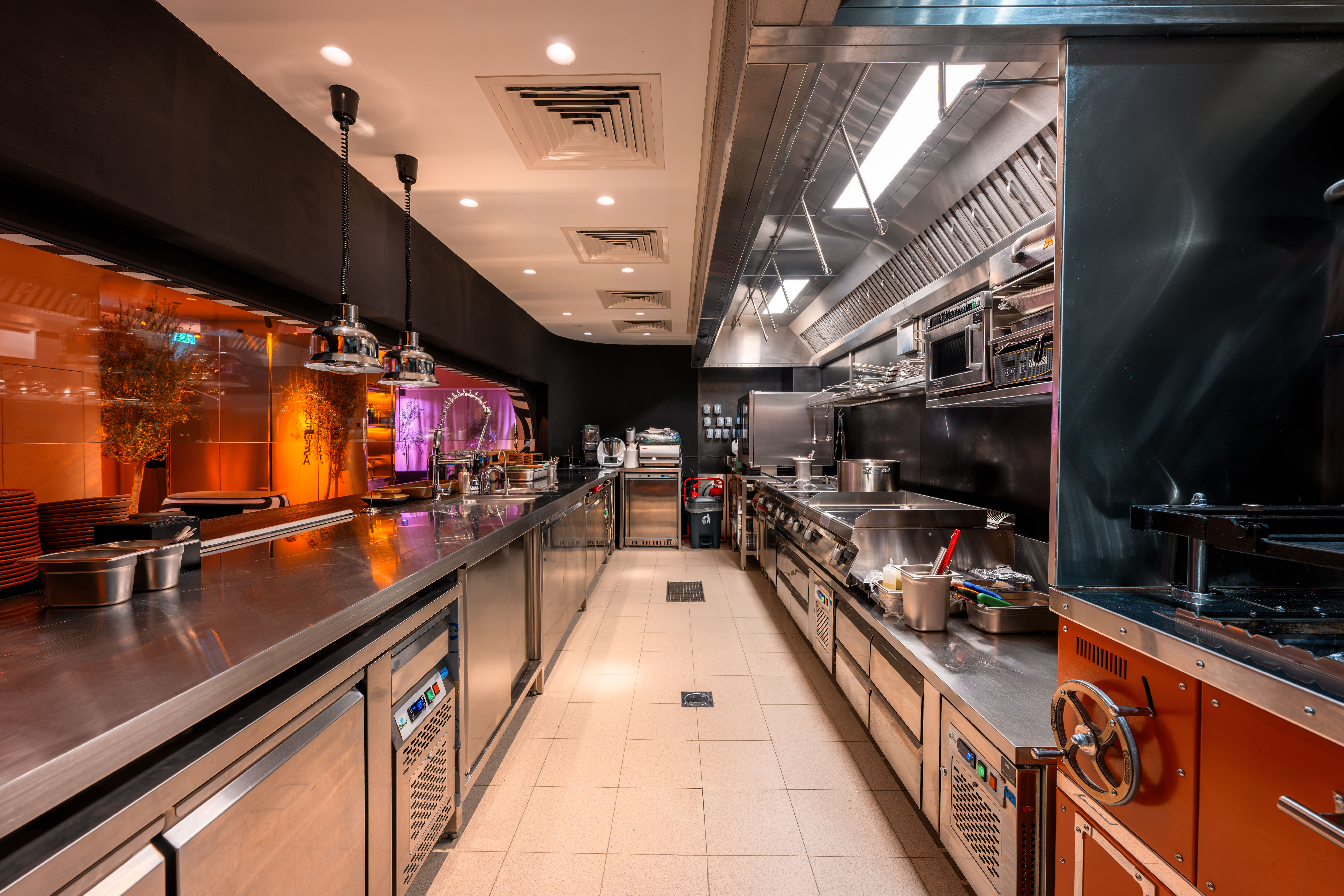
Materials shift. In a hidden kitchen, stainless steel is functional. Brushed No. 4 finish, the industry standard for food contact surfaces, and nobody cares what the back of the hood looks like. In an open kitchen, the guest-facing surfaces move to decorative finishes. Vibration finish for a textured look. PVD (physical vapour deposition) coating for colour (black, gold, copper). Mirror finish on selected panels. The material is still stainless steel, still food-safe, still cleanable. But the finish communicates craft.
When we fitted out Sobremesa, a Spanish casual dining concept with an open kitchen, there were three different stainless finishes visible from the dining room. The counter facing guests was one finish, the hood trim was another, and the back panel behind the grill was a third. All 304-grade stainless. All functional. But from the guest's chair, it read as intentional design, not industrial equipment.
Noise becomes a design variable. Extraction hoods are loud. Dishwashers are louder. In a hidden kitchen, that is fine. In an open kitchen, a commercial dishwasher cycling at peak service can overpower conversation at the nearest four-top. Equipment selection changes: lower-decibel hood fans, strategic placement of the loudest equipment behind barriers or in a separate back of house area.
Workflow becomes choreography. In a hidden kitchen, cooks move however they need to. In an open kitchen, the guest-facing stations are composed. Grilling, plating, finishing, garnishing happen in view. The messy work (breaking down proteins, scrubbing pots, receiving deliveries) gets pushed to a back prep kitchen. The cooks shouldn't have to shout or scream for things to get done even in peak service hours.
This is the reality most operators discover: an open kitchen is actually two kitchens. A show kitchen where the guest-visible work happens. And a prep kitchen behind or beside it, connected by a service corridor, where the work the guest should not see takes place. The show kitchen is smaller, cleaner, and more expensive per square metre. The prep kitchen is where the actual volume gets produced.
Open kitchen changes what "good design" means. The workflow still functions. The food safety still holds. But now the kitchen also has to perform.
The moment it goes wrong: when clients change the menu after layout is approved
Here is a scenario we have lived through more than once.
Layout approved. Equipment specified. Fabrication drawings issued. Stainless steel being cut. And then the client calls: "We are adding a pizza oven" or "We are dropping the tandoor, we are going all-grill" or "The new chef wants a dedicated pastry station."
Most of the time, the change comes from a good place. The concept is evolving. An investor gave input. A chef joined the project late and brought new ideas. The problem is not the change. The problem is the timing.
Adding a pizza oven is not adding a pizza oven. It is adding a station, which shifts the adjacent stations, which changes the aisle clearances. It adds heat, which changes the ventilation calculation for the hood above it (a pizza oven has a different thermal coefficient than a salamander or a prep bench). If the hood was already fabricated, it may need to be extended or replaced. If the electrical panel was already sized, the new oven's connected load might push it over capacity.
And there is the regulatory layer. In Dubai, the kitchen layout is part of the municipality submission. A material change to the cooking line may require resubmission, a new review cycle, and potentially a new inspection. That is weeks, not days.
Fabricated stainless steel is the clearest illustration. A countertop cut and welded to fit a specific equipment lineup cannot be re-cut easily. Rework on fabricated steel is not redesign. It is demolition and reconstruction. We are not talking about dragging a block on a CAD screen. We are talking about scrapping a piece of work and starting over.
The constructive version of this: finalize your menu before layout approval. If the menu is not locked, say so. Tell your contractor the truth. A good contractor (us included) will design with flexibility built in. Modular station widths that can absorb a piece of equipment being swapped. Uncommitted utility points, a spare gas connection or an extra electrical circuit, that give you room to change direction. Flexibility costs a little more upfront. It costs a lot less than rework.
The best time to change the menu is before you hand us the input list. The second-best time is during the station mapping phase, when moving a block on a screen is all it takes. The most expensive time is after the steel is cut.